
Eight Days Intensive Training on Dialectical Behaviour Therapy (DBT)
Training aligned with international DBT standards, with certification by Emocare — India’s first chain of counselling centres (3500+ five-star reviews on Google).
Certification Snapshot
On successful completion of the training and assessments, you will receive a Dialectical Behaviour Therapy (DBT) Training Certificate from Emocare.
Emocare is registered with the Ministry of Corporate Affairs, Government of India, and is widely recognised for its intensive programs in CBT, REBT, DBT and other therapies.
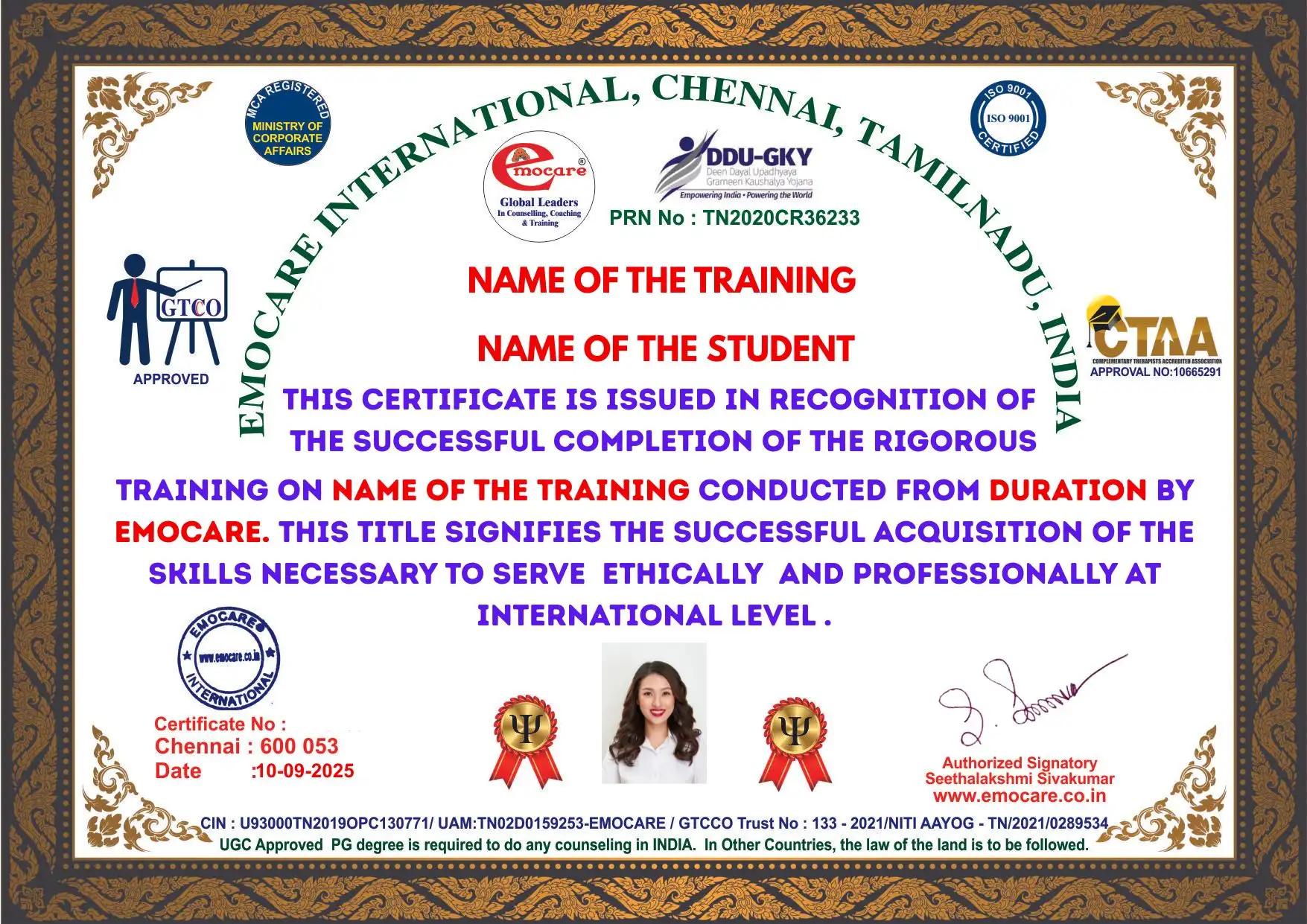 Model certificate — actual design may vary, while keeping Emocare branding and international-level formatting.
Modes of Training & Fees
Choose the mode that best fits your practice and time zone. All modes cover the core DBT concepts and skills and lead to the same Emocare certificate on completion.
Eight Days DBT Training — Detailed Syllabus
The eight-day structure is followed in the online and recorded modes. The offline mode at Chennai covers the same content in a shorter intensive format with longer daily sessions.
- Origins of DBT — from CBT to Dialectical Behaviour Therapy.
- Core assumptions and “dialectics”: balance of acceptance and change.
- DBT target hierarchy: life-threatening, therapy-interfering, quality-of-life problems and skills.
- DBT modes: individual therapy, group skills, phone coaching and consultation team.
- Client suitability, indications and contraindications.
- Biosocial theory of emotional dysregulation.
- Typical DBT client profiles (chronic suicidality, self-harm, BPD traits, high emotional sensitivity).
- Case formulation using DBT lens: vulnerability factors, triggers and maintaining cycles.
- DBT behaviour chain analysis (BCA) and solution analysis.
- Practice: writing a brief DBT case formulation from a vignette.
- Wise Mind, Emotional Mind and Rational Mind.
- Mindfulness “What” skills: Observe, Describe, Participate.
- Mindfulness “How” skills: Non-judgmentally, One-mindfully, Effectively.
- Using mindfulness to manage urges, impulsivity and dissociation.
- Designing and running mindfulness exercises in Indian / multicultural contexts.
- Acceptance vs change: when distress tolerance is primary.
- STOP, Pros & Cons, TIP skills and grounding.
- Self-soothing, distraction and improving the moment.
- Reality acceptance, radical acceptance and willingness.
- Applying crisis skills to self-harm, substance use and high-conflict situations.
- Understanding emotions: functions, myths and common misinterpretations.
- Checking the facts and changing emotional responses.
- Accumulating positive experiences (short-term and long-term).
- Building mastery and coping ahead for difficult situations.
- Opposite action and using DBT with depression, anger and shame.
- DEAR MAN, GIVE and FAST skills in detail.
- Assessing priorities between getting what you want, keeping relationships and self-respect.
- Role plays for assertiveness with family members, partners and workplaces.
- Adapting interpersonal skills for adolescents and couples.
- Homework planning for real-life practice between sessions.
- Structuring individual DBT sessions — agenda, diary cards and review.
- Designing DBT skills groups and adapting for short-term training contexts.
- Diary cards: tracking urges, behaviours, emotions and skills.
- Managing therapy-interfering behaviours and burnout.
- Documentation, risk assessment and communication with other professionals.
- Integrating DBT with CBT, REBT, TA and other approaches you already use.
- Ethical practice: boundaries, scope of competence and referral decisions.
- Using DBT elements with children, teens, couples and families.
- Implementation planning: starting DBT-informed work in schools, clinics and private practice.
- Final Q&A, supervision-style case discussion and guidance on quiz/certification process.
Trainer & Institution
Know Your Trainer
The DBT training is led by Seethalakshmi Sivakumar, Psychologist, Counsellor and International Trainer associated with Emocare. She has trained hundreds of students, counsellors and helping professionals in CBT, REBT, DBT, Art therapy, Play therapy and other approaches.
Her teaching style combines structured explanation, live demonstrations, skills practice, behaviour chain analysis and case-based discussions, so that you can begin using DBT principles responsibly in your practice.
About Emocare
Emocare is India’s first chain of counselling, life coaching and training centres, based in Ambattur, Chennai and serving clients online worldwide. Emocare has 3500+ five-star reviews on Google and is registered with the Ministry of Corporate Affairs.
Along with DBT, Emocare conducts intensive programs in CBT, REBT, Transactional Analysis, Acceptance and Commitment Therapy, Art & Play therapy, School Counselling, Couple and Relationship Counselling and more, through diplomas, PG diplomas and short-term certifications.
Frequently Asked Questions — DBT Training
Will I be able to start using DBT skills after this training?
Yes, the training is designed to be skills-focused and practical. You will learn how to teach DBT skills, use behaviour chain analysis, assign homework and track progress with diary cards, while also understanding your limits and when to refer for more intensive programs.
Do I need previous CBT knowledge to attend?
Prior CBT exposure is useful but not compulsory. The program provides enough background for beginners, while also offering deeper application and case work for experienced practitioners.
Can DBT be used only for Borderline Personality Disorder?
DBT was originally developed for BPD and chronic suicidality, but many DBT skills can be applied ethically to clients with emotion dysregulation, self-harm, addictions, eating difficulties, intense anger and relationship problems, when used within your scope of practice.
Is there any assessment or quiz?
In the recorded mode, you will complete an online quiz before downloading your certificate. In live modes, practice tasks, case exercises and participation help ensure that you can apply the DBT tools safely.
Will I get supervision support after the training?
Emocare usually provides a limited period of WhatsApp-based query support after training. This helps you clarify doubts when you start applying DBT skills with real clients.
Can international participants join this DBT training?
Yes. The online one-to-one, group and recorded modes are suitable for participants from any country. Session timings can be planned according to your time zone via WhatsApp discussion.
How to Enrol & Contact
To enrol in any mode, simply send a WhatsApp message using the links above. You can also contact Emocare for other counselling and training services.
Contact Details
Address: 19/5, Shop Street, Venkatapuram, Ambattur, Chennai, Tamil Nadu, India – 600 053
Mobile / WhatsApp: +91-7010702114
Email: emocare@emocare.co.in
Opening Hours: 9:00 am to 11:00 pm (IST)
EXPLORE EMOCARE’S OTHER SERVICES AND TRAININGS.